We drove to Goshen Indiana for the 50th Escapade, a large RV rally that is geared to fulltimers, and is put on by the
Escapees RV Club. This is our third Escapade and they do become more about seeing friends and less about going to seminars, though we did attend a few informative sessions. Of the RVing groups we belong to we have gotten the most service from Escapees, starting with Boot Camp in 2007 our first year on the road. We have also stayed in several of their RV parks in the south and out west.

We parked by our good friends Richard & Valerie Frayer whom we have met up with several times on the road after first meeting them at RV Boot Camp here in Goshen in 2007. A couple of weeks ago we received an email from their daughter Marissa, who lives in Sweden, asking us if we would be part of an international conspiracy to deliver gifts from their three girls for their 40th anniversary. Of course we jumped at the chance to be part of this surprise and had two packages delivered to us at the rally. One gift was a fruit basket and the other was a very heavy bucket of gems that were buried in sand so they had to do a little prospecting to find the rocks. They were like a couple of kids as they searched for the precious gems. We are looking forward to seeing how Val will use them in the beautiful jewelery she makes.

The opening ceremony of the Escapade. Nearly 1600 were in attendance. These events give us a chance to catch up with our RVing friends. We saw Mike & Loretta, Jeff & Pat, Lanny & Lois and others whom we have met along the way. It is a great little community of like minded people who understand the lifestyle and don't think we are crazy for living in a house on wheels.

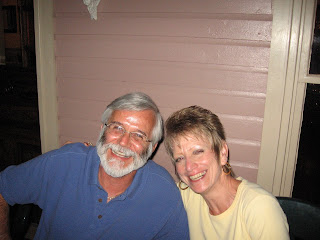
We had a happy hour potluck with members of the class of 07. Here is Nanc, Richard, Melissa & Larry Beahm, Dave & Kathy (hidden) Bennett, Marty and Valerie. We have met all of these people on the road at other stops. Melissa & Larry are entertainers who travel the country putting on shows at RV rallies and parks as the group
One More Time. Sorry I did not get a pic of Bob & Mollie Pinner, 07 mates who will be the coordinators for next year's Escapade in Gillette, Wyoming.

One thing that makes the Escapade work is people volunteering. At the last Escapade we did morning coffee and this year we worked security at the gate making sure only registered participants came into the fairgrounds. Volunteering also lets us meet more people.

Aerial pic of the 800 rigs at the rally. Ours is the one with the white roof. Actually we are the first rig in the second row in the infield of the track. That is me waving.

We did attend a few seminars including a very informative session on purchasing a kayak. Nanc loved the fit of this one. We did sessions on RV renovation, electric systems, digital cameras and traveling to Alaska. We also spent some money on a few things we needed to fix and update. The Escapade is always a great fun time to meet friends and learn more about everything RVing.


 The first bridge was the William Preston Lane Jr. Bay Bridge which crosses Chesapeake Bay just east of Annapolis to the Eastern Shore and the Delmarva Peninsula. This 4.35 mile bridge rises 186 feet above the water. It was originally just a single span with two way traffic, but a second bridge was added to separate east and west bound traffic. Nanc tells me there is quite a view from the top but I was real focused on the road.
 To add Delaware we stayed at the Seabrook Wally World that was just 100 miles from DC. Since we arrived so early we disconnected the car and drove to Rehobeth Beach. We had a nice stroll on the boardwalk and enjoyed the warm ocean air.
 The next morning we crossed the Chesapeake Bay Bridge Tunnel. This 23 mile engineering marvel crosses the water where the Atlantic Ocean meets Chesapeake Bay and connects the Delmarva Peninsula with Southeastern Virginia. We crossed it many years ago when there was only one bridge with two way traffic and we were glad to see the newer southbound bridge was wider than the original. It was wide enough that I actually got to enjoy the view as we literally drove across the ocean.
 There are four man made islands where the road goes into the two tunnels that were required so there would be no limit on the height of the Navy ships sailing from the base in Norfolk. The tunnels have two way traffic and going through them was just a little intense.
 We weren't yet done with the bridges as we had to cross the three mile Wright Memorial Bridge to get to the Outer Banks from the North Carolina mainland. This is another bridge that was once a single two way traffic span but now consists of two bridges. It was a real piece of cake after the previous two.
 And finally one last bridge to get us on to Hatteras Island. The Hebert C. Bonner bridge is a 2.5 mile span that crosses Oregon Inlet between the Atlantic Ocean and Pimlico Sound. It has been through several hurricanes and in 1990 a dredge hit it and knocked a section down, isolating everyone on the island until ferry service could be brought in. This bridge is due for replacement because erosion is constantly changing the shoreline. It has two way traffic.
 The last part of the trip is down highway 12 on Hatteras Island. Here the road is so close to the Atlantic that it is often covered in water and sand. There are some spots where the island is so narrow that you could hit a nine iron into the ocean on one side and into the sound on the other. That is why we love this place, it is so isolated that you won't find a Wally World or, for that matter, many other chains.
 We arrived at the Sands of Time Campground to find they were having a fish fry that evening so we joined in and got to meet a few other residents.
 To our Pacific coast readers it may be surprising that you can actually go into the Atlantic even in October and not freeze your ### off. The water was fine, the fishing was great, but the catching left a lot to be desired. We are looking forward to a month of just kicking back at the beach and hoping the catching gets better.