Showing posts with label Alabama. Show all posts

Saturday, March 12, 2016

Cedar Key and On to LA

The plan, always written in sand, was to take our time driving the 850 miles from Christmas to Betty's RV Park in Abbeville.  The only part that went as planned was to drive to and stay at Cedar Key.  Not only did it change because of upcoming events at Betty's, we also had to once again out run threatening weather and for two days we made changes about where we were staying after we were on the road. 
We had long planned to stay in Cedar Key, a funky little out of the way old Florida town that is at the end of the road along the gulf coast.  We were lucky to get the last spot at Sunset Isle RV Park and Motel.  While we were not right on the water, it was very close by and we were close enough to town that we never moved the car during our stay. 
Cedar Key is a working town with farm raised and wild clams being the number one product.  One of many growing and processing plants in town.
When there are clams you must eat clam chowder.  When friends read on Facebook that we were there they told us that Tony's award winning chowder was the best.  While we prefer chowder without cream sauce we both agreed this was the best we have ever had.
Beautiful "downtown" Cedar Key has many, very neat, old Florida buildings that are hotels, restaurants and artist shops.  The artist co-op had excellent locally made items as opposed to the usual imported junk one finds in most tourist stops.
Along Dock Street are several bars and restaurants offering good food and entertainment.  This is the Big Deck with a view of the little harbor.
The steamed Cedar Key clams were wonderful.  Nothing like fresh seafood, from the water to your plate in a day.
Even in the afternoon they had live music.
At the Big Deck we had one of those wow traveling experiences that happen along the road.  While eating and listening to the music this guy was sitting with his back to us.  When he turned around I said to Nanc, that is Mouse.  He is the friend of a friend from Washington and when I went over and told him we knew Chris Potts he about fell over.  Turns out he married a local girl and has lived in Cedar Key for several years.  We saw him a couple more times during our stay.  How cool and it just proves what a small world we live in.
Another working boat dock.  Even the old bridge was left in place though I would not want to cross it.  The middle is gone and it is used for storage. 
When we heard about Cedar Key, we were told that in addition to the funky town and clams, the sunsets are a big attraction and the Low Key Hideaway was the best place to watch them.  The Hideaway is a neat little six room motel and three site RV park with a tiki bar overlooking the water.
The tiki bar was built with old discarded material.  The back wall is all old doors and has this cool little garden.   All very neat.  The Low Key is owned by a couple of former, full time RVers.
The sunsets did not disappoint.  All three evenings we were there they were fabulous.  They rank right up there with the ones we see at the Elks Lodge in the Keys.
The sunny side of the tiki bar has windows that open for warm weather viewing.  They have two small wood burners for colder winter days.  The bottom half of the front wall is made out of bottles.  There is a deck and chairs on the lawn all for easy sunset viewing.
The inside is an eclectic collection of license plates, posters, pictures and more.  All in a very cozy little building.
Another evening and another great sunset.  It always amazes us how long they last and how they change even after the sun is well below the horizon.
On Friday evening they had live music to accompany the sunset.  Check out the bottle wall behind the band.  More bottle walls are under construction and they have a good source of material.  They are talking about adding three or four more RV spots all overlooking the water so maybe some day we will be able to get in to Low Key Hideaway.
Another beautiful Cedar Key home in the more up scale part of town.  Very common in old fishing villages where the sea captains have huge homes on the high ground overlooking the water.
The back side of the building on Dock Street looking out over the Gulf of Mexico.  There are a couple more bars and restaurants with great water views from their decks.  We had a fun time in Cedar Key and see a month long stay in our future.
Leaving Cedar Key was when the plan started changing.  We intended to have a nice leisurely 227 mile drive and an overnight stay before heading to Slidell, LA.  After we were on the road and realized we were entering the Central Time Zone and would arrive by 1:00 we decided to press on, adding another 85 miles,  We found the River's Edge RV Park, a nice little campground on the Yellow River.  This would make the drive to Slidell an easy 200 miles.
The next day as we zipped across Mississippi and under the harbor in Mobile, Alabama our plan changed again.  This time because we got a message from Betty that they were having a special dinner the day we were arriving and we needed to be there early in the day.  Because of that and the threat of heavy rain and wind we decided to press on another 140 miles to Breaux Bridge for a four day stay which would leave us with only a forty mile drive to Abbeville so we could arrive early in the day.
So we did over 650 miles in two days, much more driving then we normally do.  The Mighty Mississippi in Baton Rouge was already high on the levees before this latest heavy rain hit Northern Louisiana.
Before we arrived at Poche's Fish N Camp in Breaux Bridge, another message from Betty changed our plans again.  On the day before we were schedule to arrive they were having a birthday party for our friend Jean Paul that we did not want to miss.  So we only stayed at Poche's three nights and went to Betty's a day early and dry camped so we could help celebrate Jean Paul's birthday.  Isn't this lifestyle wonderful.
When setting up at Poche's we were surprised to see Joe and Kathy who were there to wait out the threatening weather.  So we had three fun days with them before we headed to Betty's for our two month stay.  This is the great thing about traveling with a plan that can be changed for bad weather or good friends.  We are now set up and looking forward to our two month stay at Betty's with so many great friends, great music, great food and great fun. 
 Laissez les bon temps rouler!!! (Let the good times roll!!!)

Friday, June 19, 2015

Tuskegee Institute & Airmen

There are two park service sites in the little town of Tuskegee that are not to be missed, Tuskegee Institute National Historic Site and at Moton Field the Tuskegee Airmen National Historic Site.  The institute was started in 1881 as the Tuskegee Normal School for Colored Teachers.  The first leader of the school, Booker T. Washington, started the school with 30 students who met in a small shanty on the grounds of a church.
A big part of the students lives was working to raise their own food. They also constructed many of the original buildings that were designed by Tuskegee architect Robert R. Taylor who was the first African American graduate of Massachusetts Institute of Technology.  They even made the bricks for the buildings on campus.  This is Tompkins hall that was the dining and assembly hall.  It still serves that purpose as well as being the student union.
The George Washington Carver Museum has many displays of his work on innovative farming methods for the Southern farmers,  While he is remembered for his work with peanuts he worked on all areas of agriculture.
The exact date of Carver's birth is not known, but he was born into slavery during the Civil War in Missouri.  In 1890 he entered Simpson College to study art and piano.  A teacher recognized his talents and urged him to enter Iowa State, where he was the first Black student, to study botany. After graduating he became the first Black faculty member at Iowa State.  In 1896 Booker T. Washington hired him to teach at Tuskegee where he stayed for over 40 years. 
Some of the artifacts from Carver's lab.
Tuskegee had a mobile school that would travel around the rural areas of the south to teach the farmers the latest farming methods that Carver and others were working on at the institute.  The Jessup Wagon was named for Morris K. Jessup, who financed the project.  
The Oaks, Booker T. Washington's private home, was also designed by Robert Taylor.  It was the most modern home in the county at that time.  Washington wanted it to be an example of what could be achieved when someone became educated.
The graves of Carver, who died in 1943, and Washington, who died in 1915.  Between the two of them they spent over 80 years at Tuskegee Institute. 
One of the areas of study at Tuskegee was aeronautics.  In the late 1930's with the war in Europe the government started the Civilian Pilot Training Program.  After Roosevelt visited Tuskegee in 1939 the institute began to receive money to train African American pilots.  Above is Moton Field, the only remaining training site. 
In 1941 the all Black 99th Pursuit Squadron started training.  The first class graduated in 1942 and graduate pilots were commissioned 2nd Lieutenants in the Army Air Corps.  Among the first graduates was Benjamin O. Davis who was already an Army captain and West Point graduate.  Davis was made a Lieutenant Colonel and given command of the 99th.  He served over 40 years and became the first Black general.  The Stearman PT-17 was used for flight training.
In addition to training 994 pilots, Tuskegee also trained about 17,000 support personnel including mechanics, communication and electrical specialists, armaments specialists, parachute riggers, cooks and others.  Many of these jobs were done by women and all those who were there were considered Tuskegee Airmen.
Of course, even though they were fighting and dying for their country, the Tuskegee Airmen still faced discrimination at home and on base.  They took up the idea of the Double V: victory at home and aboard.  Even though the segregation signs came down at Tuskegee, pilots in the 447th Bombardment Group at ironically named Freeman Field in Indiana were arrested for peacefully protesting a segregated officers club.  Finally in 1948, President Truman issued Executive Order 9981 calling for the end of segregation in the U.S. military.  
In 1944 the 99th along with the 332nd began flying the P-51, the best fighter the U.S. had during WWII.  They became known as the Red Tails when the painted the tails of the P-51 red.  They escorted bombers flying over Germany to bomb oil refineries.  During the war the Tuskegee Airmen flew 1,578 missions and shot down 112 enemy planes.  66 airmen were killed, 32 were taken as POWs and 13 were MIA.
These two pictures, now on display in the hanger here, are from the Tuskegee Airmen float we saw at the 2010 Rose Parade.  We actually saw these being made when we toured the float building company.
We even got to meet some of the airmen.  Here is Nanc shaking hands with one of the original Tuskegee Airmen, very neat.
This is the float with the Red Tails carrying several of the airmen.  The picture on the left is one of the ones we saw in Tuskegee.  If you are near Tuskegee, Alabama a visit to the institute and Moton Field should be on your to do list.

Saturday, June 13, 2015

Civil Rights---Selma to Montgomery

Montgomery was at the center for the beginning of the Civil War, Jim Crow laws and the intimidation of Blacks by the KKK and local police that followed.  This made it fertile ground for the beginning of the Civil Rights movement that fought for voting and equal rights less than 100 years later.  There are many important sites of that movement in the area.  I find this especially interesting because most of these events happened in my lifetime.
The first major event that gained national attention was started when Rosa Parks refused to give up her seat to a White man on a crowded bus.  Her arrest for breaking a segregation law that required Blacks give up their seat led to a 13 month boycott of the Montgomery buses.
The Rosa Parks Library & Museum tells the story of Parks and the boycott.  It is a walk through multi-media exhibit that starts with Parks getting on the bus, the driver confronting her and the police coming to arrest her.  It then chronicles the organization of the boycott that required providing alternate transportation for Blacks.  While all this was happening in Montgomery the case against the bus segregation laws was taken to the Supreme Court where they were overturned.  For her effort Rosa Parks is considered the Mother of the Civil Rights movement.  No photos are allowed in the museum.
The children's wing of the museum has the Cleveland Ave Time Machine, named after the bus route Rosa Parks was on.  The time machine takes you back to the 1800's and tells the story of the struggle of slaves and the events leading to Rosa Parks' defiance.  It is a good place to start if you don't know the stories of Harriet Tubman, Dred Scott, Homer Plessy and others who played a role in the long struggle for equal rights.
The Dexter Avenue Baptist Church, where Martin Luther King was the minister, was the headquarters of the boycott.  During segregation churches were the only places where Blacks could legally gather so they became the driving force of the movement.
The Dexter Church parsonage was where Dr. King lived while he was the pastor.  It was bombed during the boycott and fortunately no one was injured.
The Freedom Ride Museum at the Greyhound Bus Station was the site of the beating of Freedom Riders in 1961.  The Freedom Riders were Whites and Blacks who rode buses together in defiance of segregation policies that were still enforced despite being declared unconstitutional.  The savage beating of the riders when the bus arrived in Montgomery caused the Kennedy administration to take action to defend the civil rights of minorities.   
Fifty miles west of Montgomery in Selma is one of the iconic sites of the Civil Rights movement, the Edmund Pettus Bridge.  The events in Selma were started as a protest over the shooting of Jimmy Lee Jackson by state troopers in nearby Marion.  On March 7, 1965 600 marchers started toward the capital, Montgomery, to protest the shooting and the lack of voting rights for Blacks.  At the bridge they were meet and beaten by local and state police in what has become known as Bloody Sunday.  The bridge is a major stop on the Selma to Montgomery National Historic Trail.     
The trail, bridge, campsites, Route 80 and Dexter Ave in Montgomery are recognized as a national trail by the park service but the two interpretive centers are locally run and were not open on Sunday when we were there.  Not to worry, we met Columbus (right) and his friend who were very knowledgeable about what happened in Selma 50 years ago. 
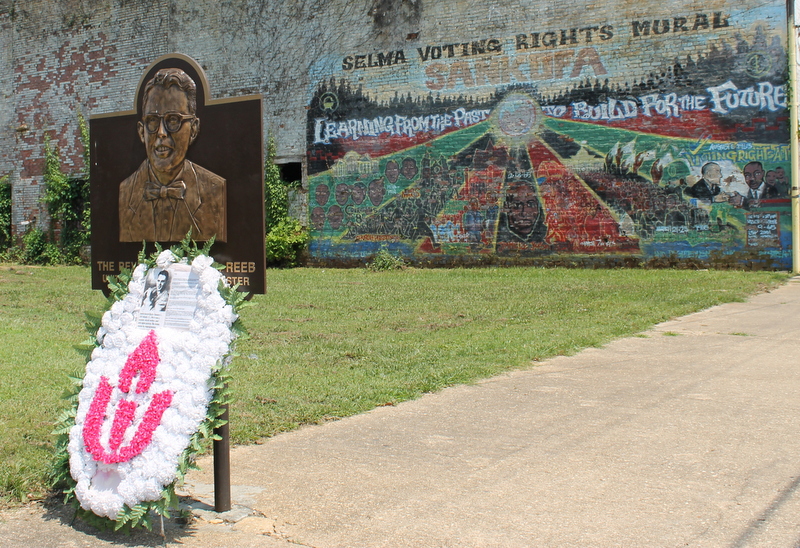
Top is a mural to honor the people killed in 1965 during and after the march, Jonathan Daniels, Viola Liuzzo, James Reeb, Jimmy Lee Jackson and in the center Dr. Martin Luther King who was killed in 1968.  Bottom are the leaders of the Bloody Sunday March.  Hosea Williams (who I met when I lived in Atlanta), John Lewis (who is now a congressman), Amelia Boynton Robinson (who was left for dead on Bloody Sunday and who, at 104, was at President Obama's side for the 50th march anniversary walk across the bridge this year) and Marie Foster (a local Selma civil rights leader).
On what is now called Turnaround Tuesday, after Bloody Sunday Dr. King lead a march of 2000 from Brown Chapel (above) to the bridge where they prayed and then returned to the chapel.  At that point President Johnson called for Congress to pass a voting rights act.  The next day a judge lifted an injunction against the march and the President ordered nearly 4000 troops and FBI agents to Alabama to protect the marchers. 
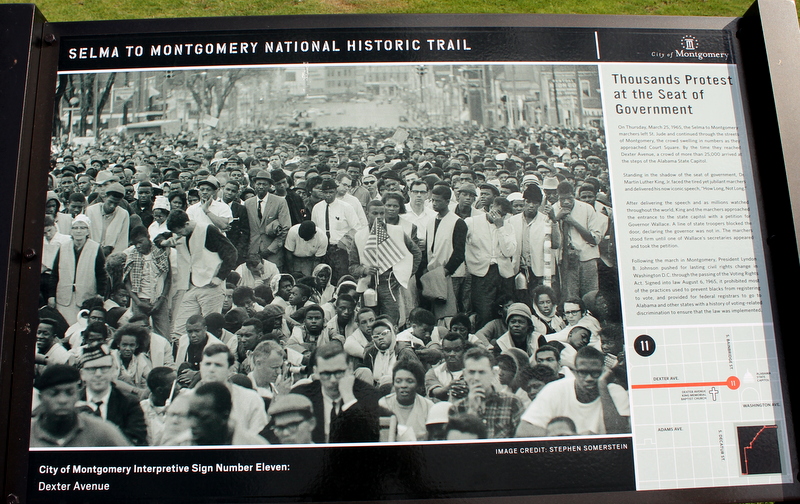
Starting on March 21 some 4000 marchers started out on the five day, 54 mile march to Montgomery.  By the time they reached the capital there were 25,000.   
Plaque and mural at the spot where civil rights worker James Reeb was shot and killed.  In his eulogy Dr. King asked, "Why must good men die doing good things?"
Monument at the spot where Viola Liuzzo was killed by the KKK after she drove marchers back to Selma.  Being here and seeing these monuments gives you a real appreciation for those who were beaten and killed because all they wanted was for all Americans to have all rights equally. 
The scene at the capital when the marchers arrived.  This march was effective and in August 1965 President Johnson signed the Voting Rights Act that ended literacy tests, called for federal monitors of elections and put in action lawsuits to end poll taxes. 
The crosswalk in front of the capitol with the footprints of marchers.  It is ironic that the march started by crossing a bridge named for a KKK grand dragon, Pettus, went along a road named for the president of the confederacy, Davis, ended at a capitol building where the segregationist governor, Wallace, wore a pin saying NEVER but resulted in passing a law they all fought against.. 
A few of the banners around Montgomery celebrating the city's Civil Rights history and 50th anniversary of the march. 
The Civil Rights Memorial was designed by Maya Lin, who also did the Vietnam Memorial in Washington, DC.  The wall is polished black granite with a biblical reference to justice quoted by Dr. King , "....until justice rolls down like waters and righteousness like a mighty stream."
On the flat fountain are inscriptions starting with the 1954 Supreme Court's Brown vs Board of Education decision that ruled segregated education was unconstitutional.  Then there are the names of forty men, women and children killed between then and the death of Martin Luther King in 1968.  As  I said, these civil rights events happened during my lifetime and I was in Atlanta for two years soon after that including when Dr. King's funeral took place there.  So it was very interesting being able to get a first hand look at where the struggles took place.