Showing posts with label Colorado. Show all posts

Wednesday, May 10, 2017

Durango, Being Towed, Then On the Road Again

As we said in the last post, we did not get to do everything we had planned while in Cortez, CO because the weather took a turn for the worse. It was so much colder that we bought another electric heater. There was a lot of snow in the mountains and a dusting in Cortez. This along with night time temps in the 20's. We think the cold weather may be why we ended up having to have Opus towed. That story is below. We did go to the casino one day and I'm happy to report I won over $230 on the free play money they gave us. I was going to buy Nanc something with that money, but it ended up going to RV repairs.
This is what the mountains looked like when we arrived, snow covered but not with much as winter was supposed to be over.
We did do a day trip to Durango, a neat old mining town that has become a go to tourist destination. 
One of the attractions is the Durango and Silverton Narrow Gauge Railroad. They were not yet open for the season but we did check out the rail yard and the museum. 
The museum has a great collection of old trains and equipment like this railroad hand cart.
One of the old steam engines they no longer use. They have an interesting video on the rebuilding of another engine that is still in service.
There are also a few old cars.
There was a neat model train display with a drive-in movie. They were showing a John Wayne movie that was filmed in Monument Valley.
Durango has several restored hotels. This is the General Palmer Hotel that was built in 1898.
The Strater has a very neat lobby and a couple interesting watering holes.
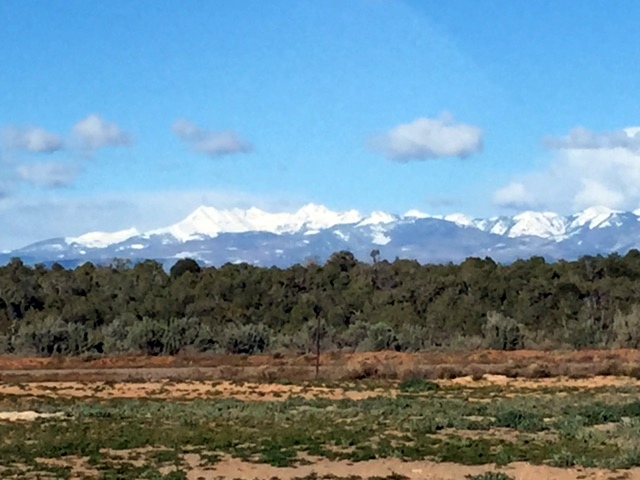
Compare this picture to the first one. There was much more snow on the mountains at the end of the week than when we arrived.
I know it is not very much, but it is still more than we wanted to see. 
Our plan was to leave Sunday and head toward Salt Lake City. Opus started right up and we let the engine warm up before driving to a gas station to fill up with diesel. Unfortunately, when we tried to start Opus the engine cranked, but would not start. We ended up sitting at the pumps for nearly eight hours. We called Coach Net, our tow service, and they put in motion the process of getting us towed to a repair facility.
While we were waiting a local diesel mechanic, Donny, stopped by and asked what our problem was. He went back to his shop and brought his computer to check the engine and even removed the fuel line to confirm Opus was not getting any fuel. He gave us a couple possible solutions but could not work on it at the pumps. He did not want any money for his effort so we gave him a twenty for a case of beer.  
The first plan from Coach Net was to tow us back to the RV park where we had been and then tow us to a repair shop on Monday. Since the tow truck had to come from Farmington, New Mexico, a 150 mile round trip, they did not want to make the trip twice so they agreed to tow us to their yard and then to Cummins on Monday morning. They first had to hook our air hose to the tow truck and then pull Opus away from the pumps. 
Next they had to attach the tow truck to the frame. When you have a 15 ton vehicle you can't just call the local tow guy, you need a big rig to tow a big rig. That is why you often have to wait a long time for them to arrive.  In addition to that, it was Sunday.
Since Opus was being towed with the back wheels down, the drive shaft had to be removed. Here we are all hooked up and ready for the two hour drive to Farmington. Before we left Cortez we got a call from the tow company that they could take us to a different repair shop, rather than Cummins, meaning we would not have to be moved on Monday morning. That's what we decided to do.
For the second time in ten years we are driving behind our house as it rolls down the road. A shout out to the guys from Southwest Auto Towing, as they were very careful pulling Opus on less than ideal roads. We heard from one friend who had a hard time keeping up in the car when their rig was towed at over 70 mph.  Yikes!! 
Here we are at Mobile Forklift and Truck Service in Farmington. To their word they started working on Opus at 7:00 am. We went to breakfast and drove through town to look at a couple places we could stay if the work took all day. Much to our surprise by the time we were back they were ready for us to take a test drive. Turned out they changed the fuel filters and that solved the problem, WOW!!! Total bill $400, a very small amount for on the road repair service.  
Since Opus was ready to go by 11:00 we decided to drive to Green River, UT, the place we were planning to go to the day before with only adding an additional 75 miles. The view through the bug covered windshield is the La Sal Mountains near Moab.
Just an interesting rock formation and the La Sal Mountains along the highway.
Here is a picture of the first time we had Opus towed after an on the road breakdown. This is the link to the blog post about that adventure. The moral of these stories is, if you RV you MUST have a good tow service. We have used Coach Net twice for tows and a couple other times just to ask their technicians about issues we had and it cost us nothing other than our annual membership fee. 

We are still behind with the blog. As I write this we have been to Salt Lake City, UT; Elko NV to see friends; and are now in Boise, ID to tour the capitol. Right now the weather is great, but the weekend is looking cold and windy so we will be here at least until the wind blows itself out.  The weather since we have been in the west has truly been bizarre!  

Friday, May 5, 2017

Four Corners, Mesa Verde and Anasazi Heritage Center

Seems like this spring we are on a mission to check items off our bucket list. We did the Trinity Site and VLA in Socorro, then Canyon de Chelly and Monument Valley on the Navajo Nation. Mesa Verde is another place that was high on our list when we went on the road that circumstances always seemed to cause us to miss.  It is now checked off and was well worth the wait. When we looked for a place to stay near Mesa Verde we found that there was a lot to do around Cortez. The long range forecast looked good so we booked a week. Unfortunately the weather took a turn for the worse, cold and s##w, so we did not get to do all we had planned.  
On our way to Cortez we stopped at Four Corners, the only place in the country where four states; Utah, Colorado, New Mexico and Arizona, meet. We have been here before but if you look closely at our picture on the left you can see why we needed to return. When we looked at that picture we took on our first visit we noticed that someone was only in three states.
What a perfect entrance to Mesa Verde National Park. In addition to being a national park, Mesa Verde is also a World Heritage Site. While we were only eight miles from the RV park to the entrance and visitors center, it is over 20 miles from there to the cliff dwellings on a road over, under and around this mesa.
The visitors center has a few exhibits and is also a research center for archaeologists.  This is where you buy tickets if you want to get an up close look at the dwellings. Left are pots that have been excavated from the ruins. Most of them are broken beyond repair. The sculpture, center, shows a person using the hand and foot holds cut into the rock climbing to their home. Right are examples of native pottery and jewelry. 
The Chapin Archaeological Museum is the best place to learn about how the Puebloan people lived. They have excellent exhibits about the crops they grew, how they built their homes and the baskets and pottery they made.
These dioramas show how the early people changed from hunters and gatherers, to farmers living in pit houses, to building and living in these impressive structures we see today. These exhibits and many of the park facilities were built by the CCC during the Depression.
There are hundreds of ruins in the area (see Canyon de Chelly post) but only a few have been restored and even fewer are open for visitors. This is Spruce Tree House, the third largest, best preserved and easiest ruin to get to for a self guided tour. The bad news is it is closed because a 2015 geologic assessment found there is a great chance of a rockfall within the site and along the paths. Rockfalls were always a concern of the Puebloans. They would put prayer sticks in any cracks they found. If the stick fell out it was a warning that the crack was getting bigger and in danger of falling.
Cliff Palace, the largest dwelling with 150 rooms and 23 kivas, was discovered in 1888 by two cowboys looking for stray cattle. Over the next 18 years they lead tourists and explorers to the site. These early visitors often slept in the ruins and took artifacts. It was not until 1906 when Mesa Verde became a national park that it became illegal to remove items.  
Cliff Palace today is open to ranger lead tours starting in May. The tour is only a 1/4 mile long but requires climbing five 8 to 10 foot ladders and 120 uneven steps. This sites is undergoing continuing restoration and preservation. 
We opted for the tour of Balcony House and it did not disappoint. This ruin contained 38 rooms and two kivas.  This tour is the most adventurous and after going down a 100 step staircase, it required climbing and crawling to give you a real up close look. You can see the ladder on the right. 
Here is our group going up the 32 foot ladder to get to the ruins. This climb is not for the faint of heart. When people lived here they used hand and foot holds cut into the rock to get in and out.
At the top of the ladder you pass through a narrow tunnel to the main courtyard. Like a house today, they had different rooms for different purposes. The rooms in the background were for storage so they have small entrances and vent holes so the food would not spoil.
The view for Balcony House. While the people lived in these cliff dwellings where they did all the daily jobs we would expect; cooking, weaving, making tools and weapons, they grew their food on the top of the mesa. The building is 600 feet above the canyon floor. 
Kiva Plaza. The Anasazi, Ancestral Pueblo people, had lived and farmed on the mesa going back to 550 AD. They only began to build these cliff dwellings in the alcoves in early 1200 AD. By the early 1300's they had moved. While there is much speculation about why they left, no one knows for sure. It was probably a combination of drought and depletion of resources like wood, soil and water.     
The kiva is a common feature of every Puebloan structure. They were all similar in design being  round and dug into the ground. It would have been covered with a roof made of timbers, juniper bark and mud with a ladder through a hole in the roof to enter. The kiva was used for religious, utilitarian and social purposes. 
All the ruins have black streaks on the ceiling from years of fires. The structures were built using sand stone blocks that were cut with harder stones because they had not metals. The few dwellings that are open for the public have been restored and reinforced to preserve them. 
The roofs of  the buildings were made with logs and fire was a constant danger. Here a fire was so hot that the color of the stone has been permanently changed. 
This is typical of the size of the rooms. Like a modern family each family would have several rooms for various purposes. 
Once you get into the ruins you have to get out. That requires crawling through this narrow tunnel. There is a mock up of this tunnel at the visitors center that people can use to see if they fit before buying tickets for this tour. There are other tours that do not require going through a tunnel.
After the tunnel there are two more 10 to 12 foot ladders to get back to the top. We would recommend the Balcony House tour for anyone who wants a tour that gives you not only an up close look at the ruins but also what it was like for these ancient people to get in and out of their homes.

Below are several ruins that can be viewed from the Mesa Top Loop Road. 
At 28 feet high, Square House Tower is the tallest ruins in Mesa Verde.
This site was used for ceremonies, not for housing.
This one is unique as it was built on two rock shelves. There is some speculation that these structures were built off the mesa because of a threat from outside forces.
The Sun Temple was a religious site built on the top of the mesa.
These ruins are a mesa top Pueblo that was used before they began building the cliff dwellings.
These are ruins of a pit house that the earlier people built before they began building the stone pueblos. They would dig a hole and then erect a roof over the top. Entrance would have been through a hole in the roof. The exhibit on the right and the ones below were at the Anasazi Heritage Center in Dolores that is part of the Canyon of the Ancient National Monument. This national monument, which has hundreds of ruins, is one the current administration wants to review and possibly open to mining and energy companies. 
The center has several excellent exhibits about how the Ancient Pueblo people lived. There is also a special exhibit about the Wetherill family. They are the people who found the ruins in 1888 while looking for their cattle. The center is a great place for an additional look at the story of the ancient Pueblo culture.
The Mesa Verde area is rich with Puebloan history and, unfortunately, we were unable to visit the Canyon of the Ancients because of the weather.  We very much recommend a visit to this beautiful and historic area.     

Wednesday, November 9, 2016

Topeka to Ojo

We left Topeka and headed west across Kansas, Colorado and into New Mexico to Ojo Caliente. The first 100 miles were on I-70 and the last 650 were on secondary highways. We love traveling these roads and seeing the small towns and cities along the way.
The rolling hills of Kansas. Even on the interstate there was not much traffic.
Actually we were more likely to encounter this kind of traffic jam on the local roads. There were signs warning to be alert for farm machinery because it is the harvest season.
 Not sure what grain this is but it looks like a work of art as it is piled on the ground before shipping.
There are fewer and fewer of these old style grain elevators, but seeing them in the distance is a sign of a small town along the railroad.
Our first stop after Topeka was Dodge City. Even though we have been here before and done all the Wild West stuff, we stayed two days to catch up on laundry after not having full hook ups at our last stop. 
The biggest change in Southwest Kansas since our 2012 visit is the huge boom in wind energy. There are hundreds of windmills spinning in the wind and many more on the ground waiting to be assembled.
In Garden City there is a huge area with parts for hundreds of windmills. These behemoths are more than 300 feet tall with turbines the size of our motorhome sitting atop towers over 200 feet in the air with three blades over 110 feet long.
We drove highway 10 across the high plains of Colorado in 2012 and it's now one of my favorites. It is a narrow two lane road, but with very little traffic. You can get the feel of what it must have been like for the early pioneers when they got there first look at the towering Rocky Mountains in the distance.
After an overnight stop at the base of the mountains, the next morning we headed over 9,413 foot LaVeta Pass. They are all set for winter with the snow fencing in place. We were surprised that there was no snow even on the highest peaks.
Another change since our last visit to Colorado is legal recreational marijuana. Every little town had a shop with the green cross. I have to say we?????????????????
Beautiful fall trees as we arrived in Ojo Caliente.
This is the third time we have been to Ojo Caliente Mineral Springs and Spa. We love coming here to soak our bones in the springs and get massages. One thing we don't like, they doubled the price of an RV spot and the only improvement was a bath house that we don't need. I guess it is just that it is becoming more popular.
There are great hiking trails at Ojo that we always take advantage of. The trees along the river where in there full fall splendor.
Once you get away from the water the high desert is covered with dry land vegetation. Here the sun was lighting up the trees in the valley below. 
Just before our last visit there was a bad flood in Ojo. On our hike we found this old wash that the flood had cleared of debris making a new trail down the hill. 
The springs are open until 10 PM and it is very neat watching the stars come out while soaking in the warm springs. 
One of the seven different springs. Each has water with different minerals that are said to cure what ails you. The Lithia water is said to improve digestion and mood.  
The big pool is the coolest and is right next to the hottest soaking pool. There is also a mud pool where you can mud up and then dry out in the warm New Mexico sun.
Nanc found this corner of the Iron Pool where the hot water was coming in on her back. The iron is said to benefit your blood and immune system, prevent fatigue and promote healthy skin tone.
I don't know if it's all the minerals, the warm high desert sun or the quiet atmosphere at Ojo, but being here sure is relaxing.
Even though we are not happy with the increase in price for the campground, we do love spending time at Ojo. This time we even ventured into "town" for a couple meals even though the restaurant here is very good. Ojo will always be a stop for us when we are in the Southwest.