Showing posts with label Nebraska. Show all posts

Saturday, July 1, 2017

Omaha -Durham Museum, CWS, Lewis and Clark and Weather

Since we scheduled a week in Omaha because of the needed repair on the slide that did not happen, we had plenty of time to explore. We did not know what to expect from a city that was once known more as a meatpacking cow town than anything else. Just like Pittsburgh no longer relies on steel, Omaha has moved on and has a thriving and diverse economy of food processing, insurance, transportation, healthcare and education. Of course, it is also the home of Berkshire Hathaway owned by Warren Buffett, the second richest man in the country. We did not see him but a local told us we just weren't going to the right restaurants. 
Our good friend Diane Jones told us the beautiful Art Deco Union Station was a must see. The station opened in 1931 and served as the main station in Omaha until 1971. It has been restored to its old grandeur and is now The Durham Museum.
There are several of these sculptures in the old waiting room. Wow, this sailor and soldier are checking out my wife.
The Art Deco interior, from the beautiful floor to the ceiling and lighting, is like stepping back in time. Sure is different from the current Omaha Amtrak station, a small one story building located down the street.
No reservation needed, just get in line and buy your ticket.
A few other pieces of art.
On the bottom level, where people once boarded the trains, is now the Durham Museum. 
We have done a couple long distance rail trips over the years and loved it. It is slower but much more laid back than flying. Nanc in the bar car, where else?
The museum has exhibits from the time of Native Americans of Nebraska through Omaha's growth as the economic center of the Midwest. This is Standing Bull who won a 1879 court case to recognize an Indian as a person.
This display was about Father Flanagan and the development of Boys Town in Omaha.
There are many exhibits about various companies like ConAgra Foods, Union Pacific Railroad and Mutual of Omaha that are based in the city and how the city changed from a cow town to an economic powerhouse.  There is also a very interesting rare coin and book collection from the late 19th century Omaha real estate agent Byron Reed. 
This exhibit is about the 1898 Trans-Mississippi Exposition, a giant celebration of the city's growing wealth and prosperity. 
The park we stayed in was at a spot on the Missouri River where Lewis and Clark in 1804 spent five days to rest and hunt for fresh food. It was called White Catfish Camp because they caught a white fish. The park has a great display about the Corps of Discovery as children see it.
The kids did drawings depicting their favorite thing about the adventure. These were turned into ceramic tiles and placed on the wall. It is a great look at the whole trip to the Pacific Ocean and back. 
In Omaha there is a park service regional office that is also a Lewis and Clark visitors center. They have a small display of exhibits about the trek. This relief shows the corps as they struggle against the current of the river.
Part of the Riverfront along the Missouri is "The Bob", the longest pedestrian bridge connecting two states in the country. The is named for Bob Kerry, a former Nebraska US senator. It connects over 150 miles of walking and biking trails on both sides of the river.
Here is  Nanc on our walk to Iowa. The view of the city and the river from the bridge is great. 
In the same area is the 30 foot tall statue Labor. It honors those whose labor built Omaha. It is on the site of what had been the largest lead refinery in the world. The flood waters in 2011 covered the blacksmith up to the hammer.
We did not take the riverboat ride, but it looked interesting. The sculpture is on the Iowa side in a park where they have light shows on the huge green.
In downtown is a huge sculpture of many people, animals and wagons called Pioneer Courage. It is a tribute to those brave people who traveled to and across Nebraska on their way west.
Since we had not planned on staying in Omaha, we had not thought about attending a College World Series game. This is one of those events that has been on my to do list, so we got tickets for the Sunday afternoon game between Louisville and Texas A & M. 
When we went to pick up our tickets they told us ours had been sold so they upgraded us, very neat. The ball park is fantastic, the game was great and the college crowd was all about having fun. If you are in Omaha in late June the CWS should be on your to do list. 
A few rays of sunshine after the crazy weather we had while in Omaha. We are happy we escaped without any damage and can't wait to get out of this wild, windy Midwest.

We have been traveling and doing so much we are even further behind in the blog. Since leaving Omaha we have been to Des Moines to tour the capitol and see friends, then West Branch to visit the Herbert Hoover Library and finally to Anamosa to get the slide repaired. We are now in Indianapolis until the 4th to check out the area. 

Tuesday, June 27, 2017

Lincoln - Nebraska's Capital

Our original plan was to spend a few days in Lincoln so we could tour the Nebraska capitol. That plan changed when we had the issue with the slide (that still has not been repaired) and decided to spend a week near Omaha. We were only 60 miles from Lincoln so we did a day trip to the capital. We stayed at Haworth Park, a community park on the banks of the Missouri River. When we returned to the park from Lincoln we were met with many severe weather warnings. We had very heavy rain and the worst winds we have encountered in our ten years on the road. We did not know how bad it was until we saw the news the next day. Several homes were destroyed and three days later over 8,000 homes were still without power. On our morning walk on the levee less than two miles from where we were staying we saw 100's of trees had been blown down. We sure were lucky to miss this tornado.   
This is the third skyscraper capitol we have toured and without a doubt the most beautiful of this style. This building is the third capitol in Nebraska and took 10 years to build so they could pay the $10,000,000 without going into debt. The style is a combination with the exterior being Art Deco and the interior using Gothic and other classic styles. It was started in 1922 with the outer square built around the old building so the government services were not interrupted. Next the old one was razed and the north, south and east arms were built. The third phase was the building of the tower and finally, the west side was completed in 1932.   
The 400 foot tower is domed at the top with a 12 foot sculpture, The Sower.  It depicts the traditional way of planting by hand and the importance of agriculture to the Nebraska way of life. At the bottom of the dome is a circle of thunderbirds, an important symbol for the native people.
The Lincoln statue was done by Danial Chester French, the same sculptor who did the Lincoln Memorial in Washington, DC. It symbolizes Lincoln standing over a grave with the Gettysburg Address on the wall behind.
The floor of the rotunda is a mosaic with Mother Earth in the middle surrounded with symbols for Soil, Water, Fire and Wind. The bands around the circles have animals found in Nebraska.
The dome 110 feet above the floor is painted with winged figures in a celestial rose of Virtue. It is one of the most beautiful we have seen.
The three murals in the rotunda represent the virtues of work. Top is Labor of the Hand and Labor of the Heart. Bottom is Labor of the Head.
Off the rotunda are two legislative chambers. The doors of the Warner Chamber celebrate Nebraska's Native Americans. The man on the right is holding a ceremonial pipe and standing on an otter. The woman with a child on her back is standing on a turtle, a symbol of fertility. A thunderbird hovers over them.
The other chamber is the Senate chamber. Since 1937, after the capitol was built, Nebraska has had the nation's only Unicameral, one house, legislature. There are 49 senators who are elected to four year terms in nonpartisan elections. Half are up for election every two years and they can only serve two terms.  
The columns in the chamber are different colors representing the diversity of the people of Nebraska. 
The hall between the rotunda and the vestibule has vaulted ceilings. The walls have six Venetian glass murals that were added in 1967 to celebrate the state's centennial.  
Four of the glass murals. Top is Tree Planting and The Spirit of Nebraska. Bottom is The Blizzard of 1880 and The Coming of the Railroad.
Each of the arches has mosaics that represent past, present and future life on the plains of Nebraska. At bottom left there is a basketball player representing sports in Nebraska.
The mosaic ceiling of the vestibule shows agriculture and native animals. The signs of the Zodiac are also shown. 
The sunrise sunset murals in the vestibule by James Penney are The Homesteader's Campfire, The First Furrow and The House Raising. They all celebrate the state's early settlers.
I guess they have not updated for a while or there are a lot of people here who want to make private calls. There were several phone booths throughout the building. 
The Supreme Court Chamber has acoustic tiled walls and tapestries. The baffled ceiling was made with over 8,000 pieces of walnut to prevent echoing. The room has corn and sunflower carvings. 
The governor's reception room is done in the Italian Renaissance style. There are murals on the walls and vaulted ceiling depicting the rights and responsibilities of citizens and their government.
Throughout the second floor corridors there are busts of people from all walks of life who have been inducted into the Nebraska Hall of Fame. Here are William "Buffalo Bill" Cody, author Willa Cather, Father Flanagan founder of Boys Town, Red Cloud who sued for and won Native American rights and newspaper man Gilbert Hitchcock.
Between the outer lower part of the capitol and the center tower are four courtyards that where never completed as shown in the original plan. The fountains in each one were being tested when we were there. The final landscaping will be done this summer. These fountains complete the original plans for the building of the capitol. 
On the fourteenth floor is the Memorial Chamber and another 70 foot high dome. The blue and gold symbolize the Nebraska sky and the red and gold sunburst the sun shining over the plains.
The purpose of the chamber was to show those ideals that portray the finer side of human nature. The eight murals in the chamber are The Scourge of Poverty, The Ideal of Universal Peace, The Scourge of Famine, The Ideal of International Law, The Scourge of Plague, The Ideal of Self-Determination, The Perils of Fire and The Ideal of Freedom
The view of Lincoln from the fourteenth floor observation deck. The height of buildings in the area is restricted so as not to take away from the towering capitol. This is one of the nicest capitols we have toured. The art is fantastic while celebrating the history and people of Nebraska.

Saturday, June 2, 2012

Heading North

If we were going to get to the Canadian Rockies before the high season, it was time to start heading north.  The only problem was the weather, with high afternoon winds in the forecast every day.  So we did something we rarely do, we were on the road before 8AM and putting more than 200 of the 300 plus mile days behind us before noon.  That may not sound like a lot to a non RVer, but last year our average day of travel was only 185 miles and we usually leave at the crack of 10AM.  Normally we follow the 2-2-2 rule, drive no more than 2 hours, travel no more than 200 miles and stop by 2 PM.  But we have a lot of miles to cover to get to Canada. 
Our first stop was in Colorado Springs where we had this great view of Pikes Peak for the Elks campground.  We stayed two days because of threatening weather and did a day trip to Manitou Springs, a neat old town with many shops and restaurants.  We did have a negative experience in Colorado Springs as some fine patriot, who does not believe in free speech, tore our 08 OBAMA sticker off the car.  We were not deterred and had a replacement attached within minutes of discovering the vandalism.
The next big driving day took us across the High Plains to Alliance, NE where the Sunset Motel and RV park accepted the half price Passport America rate for Memorial Day weekend.  The plains do have their own unique beauty with the windmills, old abandon homesteads and fields of green and brown crops.
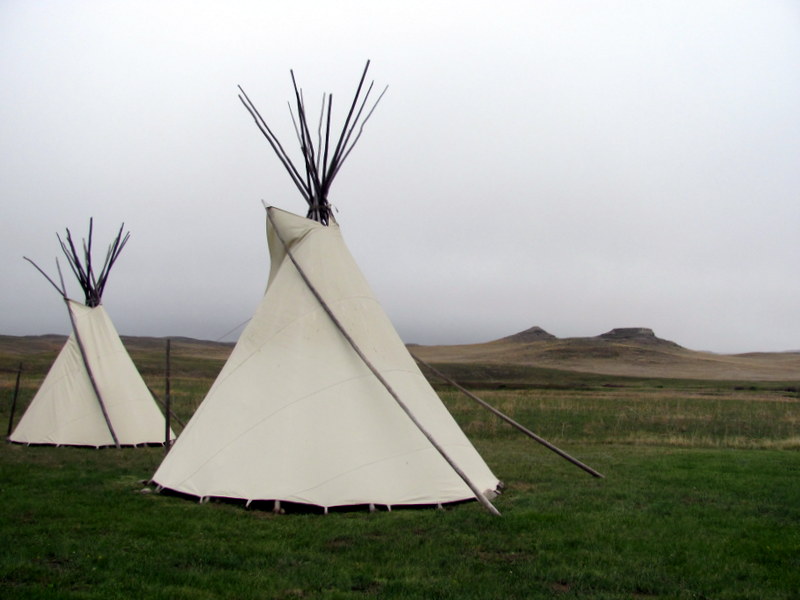
One discovery was the Nebraska panhandle does not have a lot of highways and you can often save many miles of travel if you use the unpaved roads (in the CRV, not the RV).  On this five mile stretch we met many cows, birds, pronghorns, two trees but NO vehicles.  On our return trip we did encounter a strange plains phenomenon, a fog bank like we have only seen in Labrador and on the Pacific coast.
You know you are in America's breadbasket when you see a junkyard that has only combine and tractor parts.  I was surprised to know they scrapped old equipment, from what I had seen I thought they just let it rust away behind the barn.
The goal of this drive was to add Agate Fossil Beds National Monument, the site of a huge collection of prehistoric but post dinosaur fossils, to our list.  The two hills, University and Carnegie, are where the digs took place.  There is a Pittsburgh connection here as the dig on Carnegie Hill was conducted in 1904 by O. A. Peterson from the city's Carnegie Museum.  Without realizing it I have probably seen displays of his work there on my many visits. 
The scientists believe there is such a large concentration of fossils here because during a drought the animals ate all the surrounding vegetation then gathered near the comfort of the waterhole only to die in large numbers.  These are a few of the remains of prehistoric animals like the Daphoenodon, beardog; the Monoceras, a rhino, and a Moropus, a relative of the horse.
One thing that stumped early scientists was these spiral fossils. They first thought they were a tap root of an ancient plant but later learned they were underground shelters of large, dry-land beavers, Palaeocastors, that lived in large colonies like today's prairie dogs on the High Plains.
Agate Fossil Beds also has an extensive collection of Indian artifacts that land owner James H. Cook, who first discovered the fossils, received as gifts.  Cook was friends with many Indians including Red Cloud, an Oglala Lakota (Sioux) chief.   Top are beaded moccasins.  Bottom is a buffalo hide with the story of the Battle of the Little Big Horn, the red whetstone that was carried by Crazy Horse when he was killed and Red Cloud's buffalo shirt.  This little out of the way park service site is a worthwhile stop. 
Another stop in the Sandhills of Nebraska that was on our list was Carhenge, a full size replica of the real thing that we saw in England.  We also saw a small scale replica in Texas (and you thought that everything in Texas was bigger), but this one is truly unique.  It was built in 1982 using 38 1950's and 1960's junked cars.  They are placed just like the stones in England down to the ones that have fallen and others that are half buried.  It even duplicates the real function of Stonehenge as the shadows align for the solstice and equinox. 
More recently other works of 'car art' have been added.  This one is the Fourd Seasons, that represent the four stages of the wheat crops grown in the area. 
After Memorial Day weekend it was back on the road with a stop at Fort Laramie National Historical Site in Wyoming.  The site of the fort was originally a trading post that became a military fort to supply and protect travellers on the trail used by emigrants heading to Utah, California and Oregon.  This is the old Calvary barracks.
One thing I have noticed in visiting these old frontier forts is that the barracks of the late 1800's were not that different from the ones I lived in during the 1960's.  A big room with lines of beds, no privacy and a large open mess hall.  I hope that has improved for today's soldiers.
The stones mark the foundation of an old infantry barracks and the buildings are the post commander's home and what we called the PX (post exchange).
The ruins are the officers quarters and the white building is the BOQ, Bachelor Officers Quarter, which was know as Old Bedlam.  I'm sure that is appropriate for a building housing a bunch of young officers far from civilization. It is believed to be the oldest building in Wyoming.
These are the homes of the married officers.  A great family setting for the frontier and sure a lot nicer than the enlisted barracks.  As they say in the military, RHIP! 
 
One thing the post had back then that they had when I was in, was the beer hall that had a pool table.  All the wooden cases are from Anheuser Busch.  It is great that the government has done such a good job of preserving these little traces of our past.

After leaving Fort Laramie it was on to a night at Wally World in Casper, Wyoming where we had some of the worst winds we have experienced since we hit the road.  We were glad we were parked and not out on the Interstate as a micro burst rocked us like never before.  As we continue north we are hoping for calmer winds.