Sunday, April 19, 2009

The Wild Wild West

The sunset lighting up the mountains in the East.
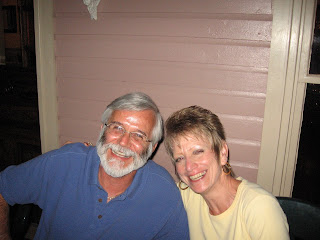
Rick & Terry Traver
Stagecoach on the main street in Tombstone.
Gun fight in the street.
A desperado goes down.
Poor Les
Victims of the gunfight at the OK Corral.
Young saguaro and its nurse tree.
Old saguaro and a dead nurse tree.
A couple old species
Saguaro Forest

We spent four days at the SKP Saguaro RV Park in Benson, AZ where we got together with Rick and Terry Traver and John Kayartz who are class of 2007 members. We first met Rick & Terry at RV Bootcamp in September of 07 and we met John at the 07 reunion in Texas this spring. It is always great to see familiar faces when you visit a new place. From the campground we were able to see the most spectacular sunset we have ever seen. The sun setting in the west lights up the mountains to the east like someone had lit millions of candles.

We drove to Tombstone one afternoon and enjoyed this old Western town that looks very similar to the way it was in the 1880's. The big difference is that many of the old bars and brothels now sell t-shirts and entertain the tourists. There are several places that offer reenactments of the large number of shootouts that occurred here. We chose the Six Gun City show and it was well worth the price of admission. After getting a short history on some of the more famous characters in town, we got to witness a few of them in action including Lester Moore whose demise is illustrated in the epithet above. Of course, the most famous gunfight here was at the OK Corral where Wyatt Earp, his brothers, the Clantons, the McLaurys and Doc Holiday went head to head. No visit to Tombstone would be complete without stopping at Boot Hill to see the graves of the famous and not so famous residents of this wild west town. Unfortunately, none of the original tombstones remain but it was still an interesting stop.

Another day we visited Saguaro National Park near Tucson to see the cacti that grows only in the Sonoran Desert and have come to symbolize the Southwest. As the park service brochure states, the saguaros are plants with personalities because of the almost human like shapes they assume. As we drove and walked through the park we stopped many times and took pictures of these wonderful giants of the desert. The saguaros dominate the landscape using the shade of shrubs and trees as nurse plants when they are young, then spreading out a large shallow root system as wide as the plant is tall. These roots absorb so much water that the saguaro kills the nurse plant as the it grows. A mature plant can soak up as much as 200 gallons of water, a year's supply, in one rain. They don't really know their exact age but they are between 60 and 75 years old before they begin to grow arms and may live for 150 to 200 years. The cacti are the homes for several species of birds who use the holes made by woodpeckers as homes that are cooled by the plant in the summer and warmed in the winter. Like each park we have visited, this one is unique with the large saguaros dominating the surrounding desert and mountains and is a worthwhile stop.

Monday, April 13, 2009

Exploring New Mexico

Nanc looking for the perfect rock.
Jim with hammer in hand.
Early tank used in the expedition against Pancho Villa.
The army was still using wagons.
The plane used in the Punitive Expedition was the Jenny built by Glenn Curtiss whose museum we toured in Hammondsport, NY. The car is like the one used by Pershing who was a horseman until this campaign.
The old train station is the home of the Columbus Historical Museum.

We have made a big change in our spring travel plans because of the weather. We were going to go to Santa Fe, Durango, Mesa Verde, and Four Corners on our way to the Grand Canyon but those areas are still getting S__W. So from Alamogordo, rather than heading north, we traveled west and are now at the Escapees Dream Catchers RV Park in Deming. Here we enjoyed an Easter potluck dinner with our follow travellers including, Ted and Lois, a couple we met last summer in Illinois. Even after only 20 months on the road we often run in to people we have met previously. From here we will be going to Benson, AZ for a few days and then we plan to travel to Apache Junction to see Sharon and Alan Frey, who we met in Rockport, TX. We have reservations for the Grand Canyon at the end of April (we hope the s__w is gone) and then will be going to Las Vegas where we will meet Mike and Sherri Sharp, friends from Wash, PA, who are flying there to start a western vacation. We also learned this week that my brother Rick and his wife Denise will be sailing to Alaska from Vancouver, BC in late July and we will have a chance to get together with them since we will be in the Northwest at that time. These are two of the great things about having a house on wheels, we can change plans based on how the wind blows (which it does a lot in the spring in the Southwest) and meet up with friends and family on the road.

While in Deming we visited Rockhound and Pancho Villa two unique New Mexico state parks. At Rockhound you are encouraged to not walk on the trails while collecting the 15 pounds of rocks each person is allowed take home. It was cool walking around with a hammer and smashing big rocks into little ones while looking for attractive stones. We think Nanc found a hollow egg but since I am a real good smasher we aren't sure. We did keep a couple of very small stones totaling about 2 ounces well within the fulltime RVer's weight limit. This is a great little park that gives nice views of the valley and the Florida (flo rita) Mountains.

Pancho Villa State Park in Columbus, NM may be the only place in America named for a person from a foreign country who attacked the United States. The visitors center has excellent displays of the March 9, 1916 raid by 485 of Villa's troops on Columbus while looking for food, arms and clothing. This was the only ground invasion on the US since the War of 1812. The US Army camp there had many more soldiers than the Mexicans believed and even though a couple of buildings were burned and 18 Americans, including eight civilians, were killed the rebels losses were 70 to 75 men because the US soldiers had modern machine guns. The real significance of the raid was the Army's expedition into Mexico that followed. The Punitive Expedition included the last use of cavalry forces and the first use of mechanical forces - tanks, trucks & planes - in combat. This paved the way for these modern machines of war being used in WW I. The expedition which went 500 miles into Mexico searching unsuccessfully for Villa was lead by General John "Black Jack" Pershing who within a few months of his return in 1917 was leading many of the same troops in Europe. Among the junior officers in the campaign were George Patton and Dwight Eisenhower who were generals in WW II. It was interesting seeing the pictures and displays that illustrated this turning point in history away from horses which armies had used for hundreds of years. There is also a a very good Columbus Historical Society Museum in the train station that shows what the town was like in 1916.

Saturday, April 11, 2009

More Alamogordo

The Dunn Solar Telescope
Inside the Dunn Telescope.
Horned lizard along the rail trail.
Rocket Garden
Jim trying to land the shuttle. I crashed three times.
Plaque honoring Joe Walker.
Chuck talks about life in space.
An actual Sputnik.
Model of the Trinity atomic bomb site.

For most of the drive from El Paso to Alamogordo we could see a large white tower up in the Sacramento Mountains. It turned out to be the top of a huge solar telescope at the National Solar Observatory in Sunspot, NM. We toured the observatory which has several telescopes and offers great views into the Tularosa Basin. We were allowed to go into the building housing the Dunn Telescope (the one we had seen on the drive) which towers 136 feet into the sky and goes down into the ground 228 feet. We talked to the astronomers who were working and could see the spectrum of the sun they were viewing. They explained what it all meant, but it was as far over our heads as the sun. Each of the several telescopes studies different parts of the sun including one set up to monitor solar activity by automatically taking pictures every minute. They still have the first telescope dome from 1950, a modified grain bin they ordered from the Sears catalog. The visitors center has several exhibits about the sun and the work of the observatory. It was neat to be able to get into the buildings and talk first hand with the scientists.

We hiked part of the Cloud-Climbing Rail Trail that follows the rail bed of the old Alamogordo & Sacramento Mountain Railway. It was built to bring timber down from the mountains. The railway climbed 4000 feet in 26 miles clinging to cliffs, using switchbacks for sections to tight for turns and trestles to cross canyons. Only a few trestles still exist. The railway helped the growth of Cloudcroft as a resort community by offering excursions. The trail allows for easy hiking along the old right-of-way through the surrounding forest.

Another local attraction we visited was the New Mexico Museum of Space History which celebrates New Mexico's role in the development of rockets and space exploration. The museum has an International Space Hall of Fame honoring those from around the world who have made contributions. Among the honorees is Joe Walker from Washington County, PA who piloted the X-15 at speeds over 4000 MPH and up to 350,000 feet. Exhibits provide information on different satellites, rockets and space programs with an emphasis on programs developed in New Mexico. There is an outdoor space park where larger rockets are displayed. We attended a program on the effects of space flight on humans given by Chuck, a volunteer who had been a back up on several flights but never got to go into space but had completed several flights in NASA's "vomit comet," a plane which is used to simulate weightlessness. He had lived in the same neighborhood and was friends with several astronauts including the original seven and Jim Lovell the commander of Apollo 13. For someone like me who got up in the middle of the night to see Sputnik pass overhead in 1958 it was neat to see one of the actual satellites on display.

We really enjoyed our time in Alamogordo and plan on returning in the future to visit other sites in the area. One thing we missed by a day was the chance to go to the Trinity Site, the place where the first atomic bomb was exploded in 1945. It is only open to the public two days a year and we missed the April visit by a day. Oh well, we find we never get to do everything we would like to at each stop and this gives us a reason to keep travelling so we can return in the future.

Thursday, April 9, 2009

Mountains, White Sand, No Ocean

Chris, Jim & Odie -- Geeks on Tour
New dunes at White Sands starting to cover the plants.
Nanc standing on top of a cottonwood tree that is buried but will remain alive as long as some branches remain exposed.
A lizard that has adapted to the white environment.
Newly plowed roads following a windy day.
Jim collecting a sample of sand in his shoes.
That is a sand storm moving the dunes.
San Andres Mountains, White Sands and Tularosa Basin from the Rim Trail.
A "flutterby" sunning on the Rim Trail.
Matilda the camel and her owner out for a walk.

We are happy to be among like minded people and finally be in a blue state for the first time since the election in November. We are staying at the Edgington RV Park in Alamogordo, NM where we were planning to stay for a couple days but because the weather in Santa Fe and Four Corners is still cold we extended it to five days which will give us a chance to enjoy many things in the area. The first day we were here Jim and Chris Guld and their dog Odie, Geeks on Tour, who we met at the Gypsy Journal Rally last fall, pulled in. Jim and Chris are fulltimers who pay for their adventure by offering seminars at RV rallies, selling computer video tutorials and other computer services. We have taken their classes, purchased their videos and read their blog and they all come highly recommended. Alamogordo is another place with strange traffic reports with the local NPR station announcing whether or not route 70 will be closed for a missile launch at White Sands Missile Range any time during the day. Also nearby is Holloman Air Force Base where the F117A stealth fighter is based. We have not seen the stealth, but I guess that is the idea.


We visited White Sands National Monument that is really like a huge beach without the water. There are 275 square miles of white gypsum sand that is slowly moving across the Tularosa Basin forming a large dune field. They look like big snow banks and after a windy day (quite often in the spring) heavy equipment is needed to keep the road open. The park service even sells snow (sand) saucers, made in Girard, PA, to glide down the slopes. The few plants that grow there are fast growing so they can establish their roots before being buried in the dunes while the tops remain exposed. Even the animals have evolved to blend in with the nearly all white environment. It is a place we have always wanted to see and it did not disappoint as it is one of the most unique places we have visited. We know the rules about never taking anything out of a national park, but we were able to collect a sample of sand when we emptied our shoes back at the motorhome.


Another day we drove into the Sacramento Mountains and did a eight mile hike through the woods in the Lincoln National Forest. This was a real change after being in the desert and plains for so long. The Rim Trail wound along the edge of the mountains among tall trees and offered great views of the Tularosa Basin and White Sands below. The nearby mountain town of Cloudcroft is only sixteen miles but some 4300 feet above Alamogordo. It is at least 10 to 15 degrees cooler, so many people have summer homes there to escape the heat of the valley. It was a neat little place with many small cottages, large homes, several inns and all the businesses to support them. We had dinner at a local pub and on the way back down the mountain we thought for a second we had had to much to drink because along the road in High Roll we saw a man walking a camel that had a flashing red light on its butt. We stopped to get a picture, so we could prove we weren't seeing things and the man told us he was just out for a little stroll so Matilda his pet camel could get a little exercise. This proves you never know what you will see if you travel off the beaten track.

Monday, April 6, 2009

Frontiers: Western to Out of this World

Fort Davis with the enlisted men's barracks in the background, the parade grounds and the officers' housing. Notice the two outlines of the officers' houses from the original fort in the foreground. They are aligned to true north while new ones are aligned to magnetic north.
The hospital has been restored and is much different than the one I worked in when I was a GI.
Interior of an officer's home.
Interior of the enlisted men's barracks. Other then the stove in the middle of the floor this is not much different than the barracks I stayed in.
Courtyard entrance of the El Paisano Hotel
Room of Giant memorabilia.
The dome in the foreground holds one of the telescopes used for the star party.
The sunset was fabulous, but it signaled a cloudy night that cut the star party viewing short.
Dome protecting the 433" HET.
This woman was Jupiter while Nanc was Mars in the demonstration of the orbiting planets.

We ended our time in Texas with a five day stay at the Overland Trail RV Park in Fort Davis. There is a lot to do here for an area that is so sparsely populated that the local NPR radio station's traffic report was the announcer stating he had passed eleven cars on his 25 mile drive to work. We toured the Fort Davis National Historical Site that includes many restored buildings from the fort that was originally built in the 1850's. The fort, town and surrounding county is named for Secretary of War Jefferson Davis who later became the president of the Confederacy. During the Civil War it was occupied by Southern soldiers who spent more time fighting Indians than Yankees. After the Civil War a new fort was built on the same site and became an important post for protecting travellers on the San Antonio - El Paso Road, which ran through the middle of the post, and in the Indian Wars of the late 1800's. The restored buildings, which include officers' housing, enlisted men's barracks and the hospital, show what it was like being a soldier on the frontier in the late 1800's. At that time many of the soldiers stationed there were units of "Buffalo Soldiers," blacks who were brought into the army starting in 1866. Most of the officers were white, but Henry O. Flipper, the first black West Point grad, served at the fort in 1880 - 81. Unfortunately, Flipper was court-martialed on trumped up issues and was dismissed from the army in 1882. He went on to be a successful civil engineer and become an Assistant Secretary of the Interior in 1921. In 1976 he was posthumously given an honorable discharge after the controversial case was reviewed. In 1999 President Clinton issued a full presidential pardon. The fort is an excellent example of the many posts that protected people and trade during the western migration.

In nearby Marfa we visited El Paisano Hotel that was used in 1955 as headquarters for the filming of the movie Giant staring Liz Taylor, Rock Hudson and James Dean. The hotel has recently been restored and we had an excellent meal in Jett's Grill. There are displays of photos, props and other memorabilia about the movie and its stars.

The high point "literally" of our stay here was the star party at McDonald Observatory. The observatory has several optical telescopes including the 433 inch (HET) Hobby-Ebert Telescope, one of the largest in the world and two others that have 107" and 82" mirrors. No, they did not let us look through the big ones but they had several, from a 12" to a 22," set up for public use during the party. Even though it was a little cloudy (just our luck) we got wonderful views of the moon, Saturn and its moons, and the nebula M-3. We were able to see tremendous details on the moon's surface and clearly see the rings around Saturn. Before the star party we attended the twilight program, a class on the movement of the planets that included an outdoors demonstration. Even though the viewing was limited by the clouds it was an AWESOME experience seeing the heavenly bodies and having an astronomer there to explain it all.

Along the Road in Texas

As we have traveled the highways and byways of Texas we have come across many unusual things that we have not documented in other blog entries. Here are just a few pictures of things we have seen as we have driven over 2000 miles of Texas roads.
You see miles and miles of long straight road, many utility poles, desert, plains and mountains.
These windmills are the best representation we could find of the WIND that constantly blows. By the way, for some reason there is NEVER a tail wind. It is always a strong head or crosswind no matter what direction you are traveling.
While there are snakes in many places, in Texas they must warn you about them at the rest stops---SCARY!!!
We had to stop at least six times for Border Patrol checkpoints as we traveled within a 100 miles of Mexico. We are glad to see they are doing their job and in answer to the standard question, "Yes we are American citizens."
Sometimes you find a business opportunity for a friend. Molly you will only need to put your name on the place and you can start selling those culinary delights you bake.
This was a first. We had to follow a bike race out of Fort Davis. It was part of the Hammerfest, a weekend long event that we watched on Saturday. One of the races was UP to the McDonald Observatory, the highest road in Texas.
We could see this balloon for miles before we came upon the entrance to the US Air Force Tethered Aerostat Radar Site that looks for low flying planes along the border.
We went to see the Marfa Mystery Lights a natural phenomenon that occurs at dusk. While we did see small bright spots in the distance, as one of the locals told us, "It's not something that will make you change your life." This pic shows what most people claim they see. An astronomer at the McDonald Observatory told us he believes the lights are a kind of mirage. You will have to stop at the special viewing area and experience it for yourself.
The last thing you would expect to find on a stretch of road where you are warned "No services for 75 miles" is a Prada store, but here it is!!!!!!!!!!!!!!!!!!!!!!!!!!!! No, we did not stop to shop, the parking lot was way to small.

Wednesday, April 1, 2009

West Texas Big Bend Flora & Fauna


We took many pictures of the flora and fauna in the Big Bend area that we would like to share. We were amazed at the brilliance and variety of colors we found in the desert. This is our first attempt at making a collage to include more photographs. You can click on each collage to enlarge it to find some of the animals that blend in with their surroundings.