Sunday, July 17, 2016

Plattsburgh and Montreal

We moved north from the Catskills to Plattsburgh near the Canadian border.  Since it was over the Fourth of July we were lucky to find the Twin Ells Campsites where they gave us the Passport America Rate even over the holiday weekend.  Mostly we just took it easy, but we did do a bit of exploring including a day trip to Montreal.
The drive north was through the Adirondack Park, one of the largest recreation areas in the country.  The park includes both private and public land.  The mountains are beautiful and the highest in New York. 
Plattsburgh is on Lake Champlain, a large natural lake on the border of New York and Vermont.  There are many marinas with both sailing and motorized boats.
Statue of Samuel Champlain, the first European to explore this area.  He was born in 1567 in France and died in 1635 in Quebec City where he was governor.
Looking across Lake Champlain to the mountains in Vermont.  It is beautiful, but I would not want to be here in the winter when it is usually cold enough for the lake to freeze enough that people can drive on it.  Plattsburgh is a beautiful stop, in the summer. 
We had been to Montreal before, but that was almost 35 years ago.  It sure has changed a lot.  This is a marina and the Old Montreal section of the city.
Old Montreal has been restored and is now a major tourist stop with its old buildings and cobblestone streets.  Most of the area is thriving with shops and restaurants. 
The main part of this area is Place Jacques Cartier built as a marketplace at the beginning of the 19th century.  At the top of the place is a statue of Admiral Nelson that was covered with wood while being cleaned. 
Loved the old watering trough.  The area is now a market for many artisans selling their works.
Montreal city hall and many of the streets in the area are being repaired to get ready for the city's 375th anniversary next year.  In 1967 Charles de Gaulle proclaimed from the city hall balcony, "Vive le Quebec librel" in support of Quebec's liberation from Canada.
We walked to Place Bonaventure, the place we stayed at many years ago.  We found the Le Castillon restaurant where we ate a fantastic meal back then, but it had just recently changed names and was not nearly as elegant as we remember.  To bad, it was really a great place to eat.  There are fountains and sculptures in the many public spaces.
There were a whole series of these martial arts sculptures.  
To give our feet a rest we took a carriage ride through Old Montreal.  It was a great way to see the city and learn a bit of history from a local.
Nanc giving the horse some tips about maneuvering the city streets.  Not that he needed any, he even backed into this parking spot without a hitch - no pun intended.
The Marche' Bonsecour dates back to the middle 1800's.  Once a large market building, it has been restored and now houses boutiques and restaurants.
These two statues are on opposite corners of Place d'Armes.  The English man holding a pug is giving a superior stare at Notre Dame Basilica, the symbol of the religious influence with the French Canadians.  The woman holding a poodle shoots an offended look at the Bank of Montreal, a symbol of British influence.  Even as the owners appear to be rejecting the symbol of the other's culture the two dogs are sniffing each other.  
At first I thought this bagpiper was being punished, but then I realized there were four of them standing in corners to help project their melodious tones. 
The Notre-Dame Basilica was constructed between 1824 and 1829 on Place de Armis.  The towers were added starting in 1841 to house the bells.
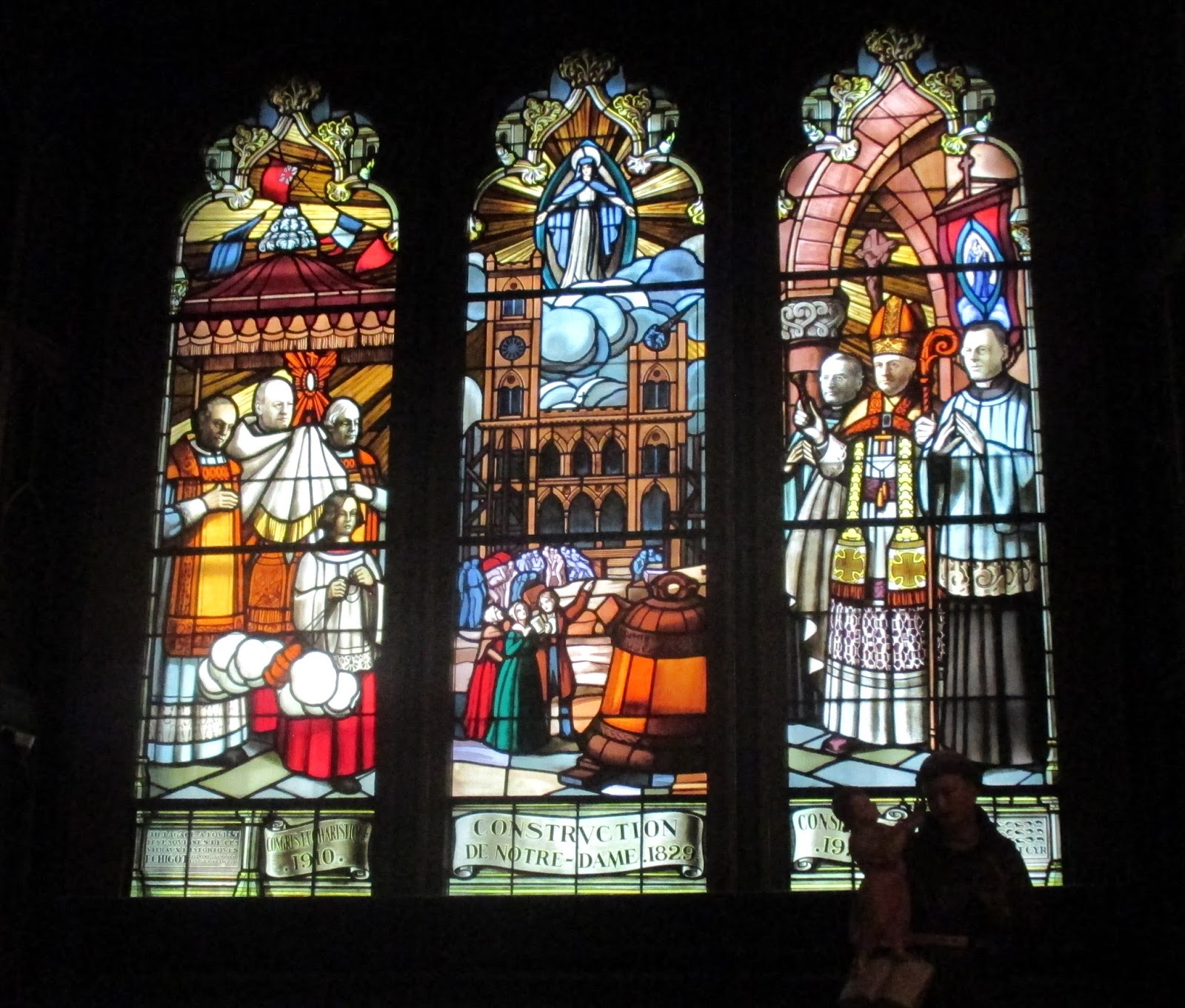
The beautiful stained glass windows honor various historic and religious figures in French Canadian history.
The sanctuary and altar.
The pulpit on the side of the sanctuary was built between 1883 and 1885.  The sculptures are by Louis-Philippe Hebert.
Behind the main sanctuary is the Chapel du Notre_Dame du Sacre'-Cocur.   The chapel was almost destroyed by fire in 1978 and was rebuilt between 1979 and 1982.  The bronze sculpture symbolizes humankind's march toward the Holy Trinity.  This basilica is not to be missed if you are touring Montreal.  There are both guided and self guided tours in French and English. A trip to old Montreal is like stepping back in time and well worth a visit. 

Sunday, July 10, 2016

Saratoga National Historic Park

On another day we did a day trip to Saratoga National Historical Site where American forces led by Major General Horatio Gates had a decisive victory over the British led by General John Burgoyne in the fall of 1777.  There is a ten mile driving or biking (if you are prepared) tour with ten stops explaining the entire battle.
In addition to this victory stopping the British from joining forces with their army in New York City and gaining full control of the Hudson River Valley, it was a great morale booster for the patriots for whom the war had not been going well. 
The visitor center has an excellent electric map that shows the fortifications and movement of both armies over nearly a month.
Regular army American and British soldiers uniforms.  The Americans also had militia and the British had Germans and Indians.   
Diorama of American fortifications.  Both sides had dug in and built these lines of defense. The Americans had built their lines earlier on the high ground that controlled the road and river to prevent the British from moving south.
British cannons captured by American forces.  While they were considered trophies they were also used against their former owners.
A demonstration of a carpenter using tools of the time.  Carpenters, blacksmiths and other craftsmen played a very important role in making repairs on military equipment.
The battlefield and farmhouse.
American lines have blue markers.  This is on Bemis Heights which gave the American troops a line of fire to the main road and the river that is now behind the trees.
The British lines are marked with red posts.  This is Balcarres Redoubt one of three British fortifications where cannons were placed to stop American attacks.  This one held while another fell.
The Breymann Redoubt that protected the British right flank was the one that fell.  During that attack American, Benedict Arnold, whose name later became synonymous with being a traitor, was shot in the leg. 
Because Arnold later betrayed the Americans and joined the British, this statue of his boot and wounded leg is the only tribute to him.  Interestingly, it does not have his name on it.   
The Great Redoubt was the strongest of the British fortifications because it had to protect the hospital, supplies, loyalists and their route of escape.  It was from behind this point where Burgoyne finally made the decision to surrender.  His army of 6,000 was facing a force of 17,000 with no chance of reinforcements or escape.  Under the terms of surrender they marched out of camp "with the Honors of War" giving the Americans their most important victory of the Revolutionary War to that point.
On another subject entirely, also while here the CRV battery, that gets a lot work because it powers our breakaway brake and needed to be jumped twice after a day of towing, had to be replaced.  Just another very small bump in the road.
I put this on Facebook, but some people may not have seen it so here it is again.  Just down the road from the campground we found a Tidball Road.  I knew there was one near Pittsburgh and one in Grove City, but finding this one in New York was a real shock.  Especially right after we had visited the Tidball grave site in West Point.  It appears there are more of us that I imagined :-)

Sunday, July 3, 2016

The New York State Capitol

We added another capitol to our list when we toured the Albany, New York building.  This building has to be near the top when it comes to grandeur, as it should be, since planning started in 1866 and the building was not completed until 1899.  It cost over $25,000,000 which is more than the cost of the U.S. Capitol.   
The building was constructed entirely of stone with the lower walls being up to five feet thick.  Hundreds of stone cutters and carvers from England, Ireland, Scotland and Wales did all the work by hand.  The exterior walls are granite which is very hard and difficult to carve.  The building has several styles of architecture including Moorish, Gothic, Victorian and Romanesque, each a reflection of the five different architects who designed the building over the years. 
Today the capitol overlooks the Empire Plaza that was built 50 years ago to house all the state government agencies in Albany.  Don't miss the observation deck on the top of the Corning Tower for a beautiful view of the capitol, the plaza, Albany and the Hudson River Valley.
The capitol at the end of the Empire Plaza.  The plaza includes many works of art and fountains.  These are two of the four identical government office towers along the plaza.
Looking down the plaza from the capitol is The Egg, a concert hall, the Corning Tower and the New York State Museum.
A few of the art works in the concourse under the plaza and in the lobby of the Corning Tower.  Almost all the art work in the Empire Plaza complex is contemporary. 
There are three main staircases in the building, The Senate Staircase (here), the Assembly Staircase and The Great Western Staircase.  These staircases were built with granite and Corsehill sandstone imported from Scotland.  The sandstone was easier to carve and the staircases have some of the most ornate carvings in the building.
While there are carvings of many famous people, General Sheridan here, the architect told the carvers to just cover the walls with carvings and to not repeat any, so they often just did faces of family and friends.  The main figures on one floor are from the Civil War and on another floor from the Revolutionary War.
The Great Western Staircase is know as the Million Dollar Staircase.  In addition to the carvings there is a greenhouse like skylight on the roof over the staircase.  While skylights where incorporated into the original design they were later covered until recent renovations.  The need for these skylights was lessened when the capitol became the first public building in the country with electric lights.   
Alexander Hamilton at the top of the column.  This is a great example of the intricate carvings.  It is neat to be able to get a close up look at these unique works of art.
George Washington 
While there are over 150 carvings of famous men there are only eight of women.  This is author Harriet Beecher Stowe. 
Hidden in a small nook in the hall at the bottom of the staircase is a carving of a small devil.  The carver, who was being fired but was told to work out the day, was said to have done the carving as a curse on the building.  The black on the stone is from people using an open flame over the years to see this small figure (pre iphone lights).
The capitol does not have an exterior dome even though one was in the original plan.  But it does have an interior one where the dome was to be.  These scenes of the French and Indian War, Revolutionary War, Civil War and WWI were painted by William deLeftwich Dodge. The plan to remove the floor below were scrapped and it is now the Governor's Reception Room.  
The state seal of New York has the sun raising behind a mountain range overlooking the Hudson River.  The two women are Justice with her sword ready to strike against tyranny and Liberty with her foot on a crown symbolic of the end of the monarchy. 
First U.S. president George Washington and first New York Governor George Clinton.  These paintings are in two different places in the capitol but it is interesting that they are mirror opposites.
The Hall of Governors includes portraits of most New York governors.  These are the four who became president, Martin Van Buren, Grover Cleveland, Theodore Roosevelt and Franklin Roosevelt. 
The 63 member Senate Chamber has been restored to its original 1881 appearance.  The chamber is a blend of several different building materials and styles.  The background of the collage above is the ceiling of this chamber.
The 150 member Assembly Chamber.  This chamber originally had a stone vaulted ceiling, but after only ten years it began to collapse and was replaced.
The East side that overlooks the Hudson River was the original main entrance. The public now enters from Empire Plaza.  If you are interested in touring capitols make sure New York's is on your to do list.  It is without a doubt one of the most interesting and ornate that we have seen.