Saturday, June 13, 2015

Civil Rights---Selma to Montgomery

Montgomery was at the center for the beginning of the Civil War, Jim Crow laws and the intimidation of Blacks by the KKK and local police that followed.  This made it fertile ground for the beginning of the Civil Rights movement that fought for voting and equal rights less than 100 years later.  There are many important sites of that movement in the area.  I find this especially interesting because most of these events happened in my lifetime.
The first major event that gained national attention was started when Rosa Parks refused to give up her seat to a White man on a crowded bus.  Her arrest for breaking a segregation law that required Blacks give up their seat led to a 13 month boycott of the Montgomery buses.
The Rosa Parks Library & Museum tells the story of Parks and the boycott.  It is a walk through multi-media exhibit that starts with Parks getting on the bus, the driver confronting her and the police coming to arrest her.  It then chronicles the organization of the boycott that required providing alternate transportation for Blacks.  While all this was happening in Montgomery the case against the bus segregation laws was taken to the Supreme Court where they were overturned.  For her effort Rosa Parks is considered the Mother of the Civil Rights movement.  No photos are allowed in the museum.
The children's wing of the museum has the Cleveland Ave Time Machine, named after the bus route Rosa Parks was on.  The time machine takes you back to the 1800's and tells the story of the struggle of slaves and the events leading to Rosa Parks' defiance.  It is a good place to start if you don't know the stories of Harriet Tubman, Dred Scott, Homer Plessy and others who played a role in the long struggle for equal rights.
The Dexter Avenue Baptist Church, where Martin Luther King was the minister, was the headquarters of the boycott.  During segregation churches were the only places where Blacks could legally gather so they became the driving force of the movement.
The Dexter Church parsonage was where Dr. King lived while he was the pastor.  It was bombed during the boycott and fortunately no one was injured.
The Freedom Ride Museum at the Greyhound Bus Station was the site of the beating of Freedom Riders in 1961.  The Freedom Riders were Whites and Blacks who rode buses together in defiance of segregation policies that were still enforced despite being declared unconstitutional.  The savage beating of the riders when the bus arrived in Montgomery caused the Kennedy administration to take action to defend the civil rights of minorities.   
Fifty miles west of Montgomery in Selma is one of the iconic sites of the Civil Rights movement, the Edmund Pettus Bridge.  The events in Selma were started as a protest over the shooting of Jimmy Lee Jackson by state troopers in nearby Marion.  On March 7, 1965 600 marchers started toward the capital, Montgomery, to protest the shooting and the lack of voting rights for Blacks.  At the bridge they were meet and beaten by local and state police in what has become known as Bloody Sunday.  The bridge is a major stop on the Selma to Montgomery National Historic Trail.     
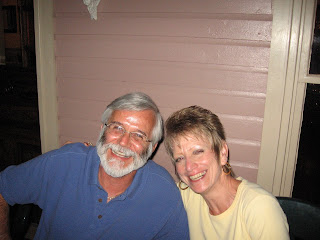
The trail, bridge, campsites, Route 80 and Dexter Ave in Montgomery are recognized as a national trail by the park service but the two interpretive centers are locally run and were not open on Sunday when we were there.  Not to worry, we met Columbus (right) and his friend who were very knowledgeable about what happened in Selma 50 years ago. 
Top is a mural to honor the people killed in 1965 during and after the march, Jonathan Daniels, Viola Liuzzo, James Reeb, Jimmy Lee Jackson and in the center Dr. Martin Luther King who was killed in 1968.  Bottom are the leaders of the Bloody Sunday March.  Hosea Williams (who I met when I lived in Atlanta), John Lewis (who is now a congressman), Amelia Boynton Robinson (who was left for dead on Bloody Sunday and who, at 104, was at President Obama's side for the 50th march anniversary walk across the bridge this year) and Marie Foster (a local Selma civil rights leader).
On what is now called Turnaround Tuesday, after Bloody Sunday Dr. King lead a march of 2000 from Brown Chapel (above) to the bridge where they prayed and then returned to the chapel.  At that point President Johnson called for Congress to pass a voting rights act.  The next day a judge lifted an injunction against the march and the President ordered nearly 4000 troops and FBI agents to Alabama to protect the marchers. 
Starting on March 21 some 4000 marchers started out on the five day, 54 mile march to Montgomery.  By the time they reached the capital there were 25,000.   
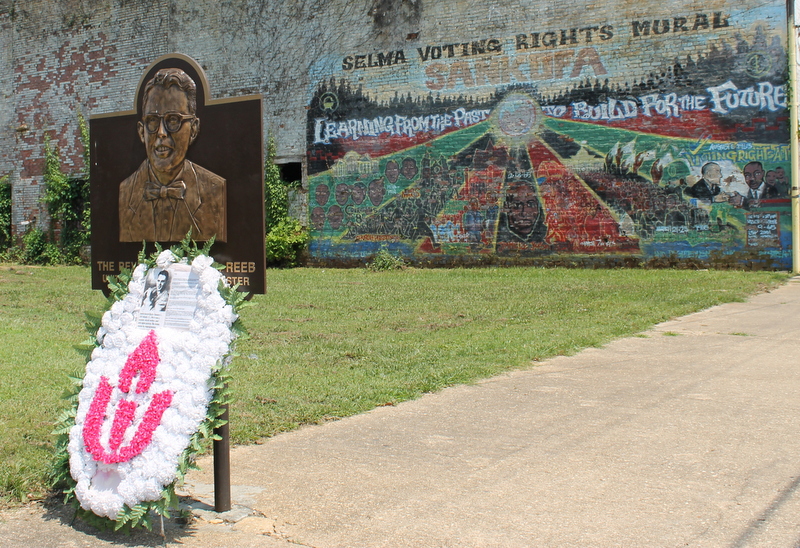
Plaque and mural at the spot where civil rights worker James Reeb was shot and killed.  In his eulogy Dr. King asked, "Why must good men die doing good things?"
Monument at the spot where Viola Liuzzo was killed by the KKK after she drove marchers back to Selma.  Being here and seeing these monuments gives you a real appreciation for those who were beaten and killed because all they wanted was for all Americans to have all rights equally. 
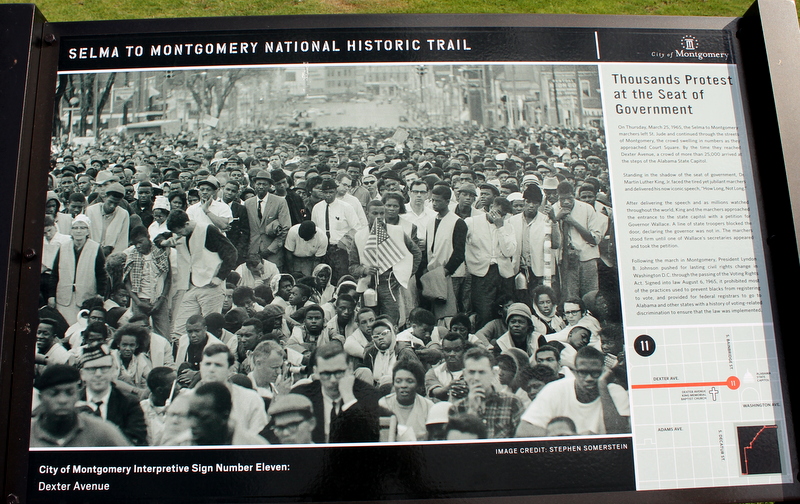
The scene at the capital when the marchers arrived.  This march was effective and in August 1965 President Johnson signed the Voting Rights Act that ended literacy tests, called for federal monitors of elections and put in action lawsuits to end poll taxes. 
The crosswalk in front of the capitol with the footprints of marchers.  It is ironic that the march started by crossing a bridge named for a KKK grand dragon, Pettus, went along a road named for the president of the confederacy, Davis, ended at a capitol building where the segregationist governor, Wallace, wore a pin saying NEVER but resulted in passing a law they all fought against.. 
A few of the banners around Montgomery celebrating the city's Civil Rights history and 50th anniversary of the march. 
The Civil Rights Memorial was designed by Maya Lin, who also did the Vietnam Memorial in Washington, DC.  The wall is polished black granite with a biblical reference to justice quoted by Dr. King , "....until justice rolls down like waters and righteousness like a mighty stream."
On the flat fountain are inscriptions starting with the 1954 Supreme Court's Brown vs Board of Education decision that ruled segregated education was unconstitutional.  Then there are the names of forty men, women and children killed between then and the death of Martin Luther King in 1968.  As  I said, these civil rights events happened during my lifetime and I was in Atlanta for two years soon after that including when Dr. King's funeral took place there.  So it was very interesting being able to get a first hand look at where the struggles took place.

Wednesday, June 10, 2015

Montgomery, The Capitol Building and The Civil War

We moved on to Montgomery planning to stay five days to tour the capitol and several historical sites in the area.  Montgomery was at the center of the beginning of the Civil War in the 1860's and then 100 years later at the center of the Civil Rights movement. We soon realized there was more to see and do than we could handle in five days so we added a couple more days to our stay at the Gunter Hill Corps of Engineers campground. 
The capitol building was built on Goat Hill in 1850-51 and replaced an earlier building at the same site that burned.  The design is Greek Revival with a central dome topped rotunda and three wings to house offices and the legislature.  The east wing shown on the right was added in 1885, the south wing with the columns was added in 1906-07 and the north wing on the opposite side was added in 1911-12.  An east wing addition added in 1989-92 is at street level and below ground. 
Looking down Dexter Avenue there are other government buildings and a few businesses lining the street.  This area has undergone a major redevelopment in recent years.
The Court Street Fountain at the foot of Dexter Avenue was built in 1885.  This area was once the center of commerce. 
The capitol looking up from Dexter Avenue.  The statue on the left is Jefferson Davis who was sworn in as the president of the confederacy in the capitol. His inaugural parade with the band playing Dixie took place along Dexter Avenue.
A memorial to all those from Alabama who have given the last full measure since 9-11-2001.  The memorial is in the capitol's old Supreme Court Chamber.
The old House of Representatives chamber has been restored to its 19th century appearance with plain whitewashed walls.  Much different from the more ornate chambers we have seen in other capitols.
The dome over the rotunda has plasterwork and a stained glass skylight.  The eight murals were painted by Roderick MacKenzie between 1927 and 1930.
The historic murals range from the hostile meeting of Spanish explorer, DeSoto and Tuscaloosa, an Indian Chieftain (center) to the first established French colony near Mobile (right) through the post Civil War agriculture, commerce and industrial development (left).  Of course there are also murals about the wealth and leisure of the Antebellum period and the secession of the confederate states.  While I do understand the importance of history I still find it hard to understand the celebration of a lifestyle and economic system based on suppression and use of slaves for labor.    
The restored old Senate chamber where Davis took the oath of office as the president of the confederacy.
Following the Civil War there was a 10 year period of Reconstruction where the Federal government oversaw the government of the Southern states.  With Union troops here to assure that former slaves were given the rights that were created by the post war Constitution Amendments, many Blacks were elected and served in the Alabama legislature.  When the troops left in the late 1870's groups like the KKK began to intimidate and deny Black citizens their newly won rights leading to a period of Jim Crow laws. 
In 1985 the House and Senate moved into the new Alabama State House, while the governor and other officials still have their offices in the capitol building.
We even got to see the legislature in action or is it "inaction".  They were debating the budget bill and it was very interesting seeing and hearing how the wheels of government slowly turn.  They did pass a budget, but the governor did not sign it so they will be back in special session when they come to an agreement with him.
The leadership on the rostrum as two legislators debate at the podiums.  The gallery, which is behind glass, was filled with many people who we assume were staffers and lobbyists.
Here are some of the other attractions to add to your to do list in Montgomery.
Near the capitol is the first white house of the confederacy that was the home of Jefferson Davis until the capital was moved to Richmond in the summer of 1861.
Located downtown is a Hank Williams Museum and statue of this famous Alabama native.  Hank's career started here when at 14 he won a local talent contest.  The museum has memorabilia of his very short but highly successful life from Montgomery to the Grand Ole Opry.  There are suits he wore, his many records and the car he was riding in when he died in 1953 at age 29.  His funeral in Montgomery was attended by more than 25,000 people.  A visit to this museum is a very worthwhile trip down memory lane with the many famous songs Hank wrote. No photos were allowed.
Another neat stop is the replica of the Wright Flyer.  The Wright brothers opened the first civilian aviation school in the United States in Montgomery in 1910.  The field where the school was located is now Maxwell Air Force Base.
We even found a brew pub, Railyard Brewing, in Montgomery.  The beer was very good, the food was OK and we met several people there and learned a bit about Montgomery.

Other major attractions around Montgomery are those related to the Civil Rights movement of the 1950's and 60's.  There are many so that will be the subject of the next blog.

Saturday, June 6, 2015

Jackson & Mississippi State Capitol

We did not have state capitol building tours on our to do list when we started on the road eight years ago, but after visiting a couple we have found that each one gives a unique look at the state's history. So this summer as we travel across the Southeast we have capitol tours as one of our goals.  Our first one was the Mississippi capitol in Jackson.  I will be adding a U.S. State Capitol Buildings label to find older posts covering capitols we have visited.  
Well, as you can see, the building is undergoing a major renovation.  
The domes over the rotunda and legislative wings are surrounded by scaffolding. 
Here is a picture I found on line.  Like so many state capitols, the design is Beaux Arts style that was popular when it was built in the early 1900's.  Like the United States Capitol, the capitol has a domed covered rotunda and two wings to house the Senate and House of Representatives Chambers.
One thing that really stands out in this capitol is the lighting.  The windows, skylights and 4,750 light bulbs, a new technology when the building was designed, all illuminate the interior.  Even with some of the glass covered for the renovation you still can see how the light highlights the interior.  This is looking up at the inside dome over the rotunda. 
The mahogany podium of the Senate chamber.  Mississippi has 52 senators.
The skylight dome over the Senate chamber.  Around the center of the dome is the inscription "The people's government - made for the people - made by the people - and answerable to the people."
Another common feature of the Beaux Arts style is the grand staircase that rises from the second (main) floor to the fourth.  On the landing there are three stained glass windows, but this one, the Pioneer Settler, was the only one in place because of the renovation. 
The background of the collage is the glass cylinder floor on the fourth floor that allows light to shine through the stained glass ceilings below.  Top is a relief of blind Lady Justice and an ornate capital of the columns that support the dome.  Bottom are ornate supports under the House gallery.  The first floor Hall of Governors has portraits of all the governors in the order of their service.  I found this one of  Adelbert Ames interesting as he was an Army officer from Maine who served a year as governor during Reconstruction after the Civil War.
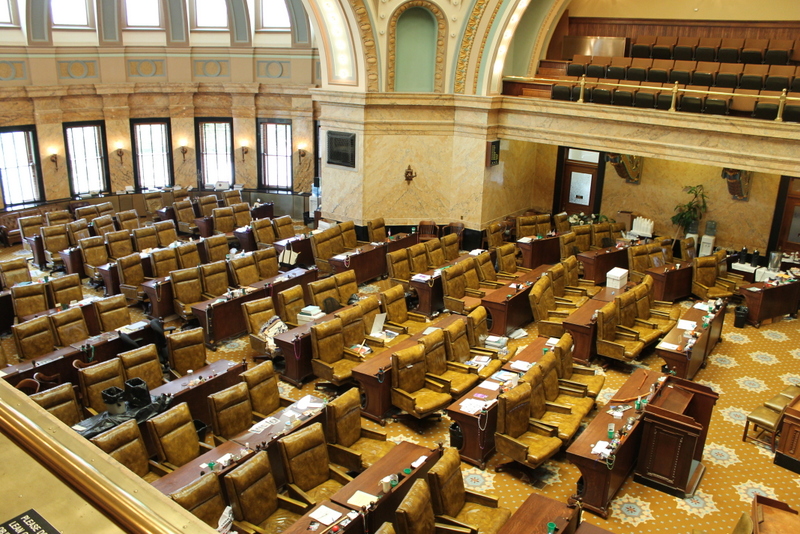
The House of Representatives chamber for the 122 members.
The skylight over the House chamber with stained glass and light bulbs on the ribs.  The Mississippi capitol is a beautiful building that we may have to return to see after the renovation is complete.
Down the street is the old capitol that is the oldest building in Jackson.  It was constructed in 1839 and was Mississippi's first permanent state house.  It was abandoned after the new capitol was built then later was used as an office building.  It was renovated after being badly damaged in 2005 by hurricanes Katrina and Rita and is now a museum
The Mississippi War Memorial is on the grounds near the old capitol.
The relief on the front of the war memorial starts with fighting soldiers on the left and ends with the weapons being turned into plowshares.  A hopeful, but doubtful ideal.
The Mississippi Supreme Court building is also part of the government complex.
The governor's mansion in downtown Jackson.
Also in Jackson is the home of Pulitzer Prize winning author Eudora Welty.  The home is now open for tours, but we were there on Monday and it was closed as were the other 
buildings except the capitol.
We enjoyed our time in Jackson and found a very good restaurant, Manship Woodfired Grill, that is worth a stop for pizza and a brew.